Friday, 31 March 2017

Reliance Jio clocks over 72 million Prime members, deadline extended till Apr 15, Rs. 303 recharge offers free services till June

Mukesh Ambani, Chairman and Managing Director of Reliance Industries today announced that Reliance Jio now has over 72 million, and still counting in a month of starting Prime enrollment. He said that this is the largest migration from free to paid services in history in such a short period of time.

Reliance Jio is also extending the deadline for purchasing enrollment of Jio Prime as well as its recharge of Rs 303 to enjoy benefits of the Happy New Year offer, including full bouquet of Jio’s media services and other plans till 15th April.

Jio also announced new Jio Summer Surprise for its Jio Prime members. Every Jio Prime member, when they make their first paid recharge prior to 15th April using Jio’s Rs 303 plan or any higher value plan will get services for the initial 3 months on a complimentary basis.

The paid tariff plan will be applied only in July, after the expiry of the complimentary service. Jio also said that users who do not recharge by the
extended date of 15th April will experience degradation and/or discontinuation of services.

Mukesh Ambani believes that the complimentary period will help to familiarize Jio customers with Jio’s fully digital, self-service process of using the MyJio app to perform recharges and to set up digital
payment methods for further purchases.
Share:

Thursday, 30 March 2017

LeEco's On Again, Off Again Vizio Acquisition May Be Off For Good

After being sidelined by cash flow problems and a privacy invasion lawsuit, LeEco's $2 billion acquisition of Vizio may be permanently scuttled, this time by China's restrictions on cross-border movement of capital.
"LeEco's US$2 billion acquisition of American consumer electronics developer Vizio Inc. may have to be aborted due to China's capital control rules, according to Chinese media citing insiders. LeEco agreed to acquire Vizio last July after two years of negotiations."
Share:

Wednesday, 29 March 2017

Google Maps Tool Lets Users Share Their Location with Friends

An update to Google Maps contains a handy tool that lets users share their location with friends. No more need to let someone know that you are going to be late.
Using the new Google Maps update “Share Your Location,” friends can track your route and know when you will arrive.
What share your location does
When you share your location using Google Maps, your friends can follow where you are in real time. Your location on the map will change as you move.
Users can share their location for a limited period of time that they choose. Or they can set it to share their location until it is turned off. The Google Maps app will let you know when you are sharing your location so you do not forget to turn it off.
This tool works with iPhone and Android, and also on computers. Even if you have an iPhone and your friends have Android phones, you can share your location with them using Google Maps.
You can even send your location to people who do not have a smart phone. If they use a computer, they can see where you are on the Google Maps website - provided you have shared your location with them.
You can send your location to anyone in your list of Google contacts. You can also share your location with someone who is not in your contact list. Just send them a link.
You can share your location with as many people as you want.
Sharing your route
If you are using Google Maps to navigate, you can send your route in addition to your location. That way your friends will know the way you are going and see when you are expected to arrive.

How to use share your location in Google Maps
After the app has been updated you can begin to share your location with others using Google Maps.
You must have the Google Maps app to use this feature. This app comes standard on Android phones. If you have an iPhone, you can download the Google Maps app for free at the iTunes App Store.
After you have downloaded the app, log into your Google account.
Open the app and tap the blue dot that shows where you are. A menu will show. Tap "Share Location" then choose which of your contacts you would like to share your location with and for how long.

Next, tap "Share" to begin sharing your location. An icon will appear as long as your location is being shared.
Google Maps Sharing Location


How to share your route
When you are using Google Maps on your phone to navigate, tap the "More" button at the bottom of the screen. Then tap "Share trip" and choose which people to share your trip with and for how long.
You can choose to share your route for a specific time period or until you arrive at your destination.
What else you need to know
You can turn off sharing your location at any time. Even if you have set a time period for sharing your location, you can cancel it whenever you want.
Google has not given a date for this update to be available. The announcement simply said it is "coming soon."


Share:

Samsung Galaxy S8 and S8+ Goes Official With Bezel-Less Displays and Snapdragon 835 SoC

After being in the news for a long time, Samsung announced their first flagship series of 2017 and the eighth Galaxy S series smartphones- the Galaxy S8 and S8+. In line with all the rumours and leaks, the smartphones have the bezel-less display and feature an entirely new design when compared to their predecessors.

The all new Galaxy S8 and S8+ come with the same glass back as seen in the previous two iterations of Galaxy S series of phones. However, this time around, Samsung has gone with the onscreen navigation keys instead of hardware capacitive keys to make the phones more compact. Coming to the display part, both the Galaxy S8 and S8+ features Super AMOLED QHD+ screen, same as the LG G6. The Galaxy S8 has a smaller 5.8-inch display, and the S8+ inherits a 6.2-inch display.
Even though boasting bigger screens, both the phones feel compact in hands, thanks to the new 18:9 aspect ratio. Both the phones feature top-notch hardware as well. The Qualcomm Snapdragon 835 powers both the phones along with 4GB of RAM and 64GB of onboard storage. If you stay in some European and Asian regions, you will be greeted with the Exynos 8895 variant of the phone.
The Galaxy S8 and S8+ comes with the IRIS scanner, same as the one seen on the discontinued Galaxy Note 7. They are IP68 certified and can submerge under water for 30 minutes. Samsung decided to not move from the 3.5mm headphone jack, and the new flagships now come with USB Type-C port, which has become a norm in modern day smartphones.
Connectivity wise, the S8 and S8+ features Wi-Fi, Bluetooth v5.0, and 4G LTE. The phone can deliver insane data speeds on LTE with the help of new Snapdragon 835 chipset. The fingerprint sensor, on both the phones, is now placed awkwardly beside the rear camera module.


As usual, Samsung is incorporating the best camera setup on both the phones. The Galaxy S8 and S8+ features a 12MP sensor at the rear of a larger f/1.7 lens clubbed with Optical Image Stabilisation, and dual tone LED flash. Up front, there is an 8MP front-facing camera with the screen flash feature. The sensor in the phones features the latest Dual Pixel technology, which means that they can focus much faster. With the larger f/1.7 lens, the camera can capture more light even under low-light conditions.
The latest iteration of Galaxy S series runs Android Nougat based on Samsung’s TouchWiz UI. The company has come up with the rival for Google Assistant and Siri in the form of ‘Bixby,’ which is an Artificial Intelligence Assistant. Also, Samsung has added a dedicated Bixby hardware button to use the new engine quickly. Having said that, Bixby performs basic operations such as calling a person, letting you know the weather, time, and other essential stuff.

Coming to the most anticipated aspect of the phones, the Galaxy S8 is priced at 809 Euro (approx. Rs. 57,200), whereas the S8+ retails for 909 Euro (approx. Rs. 64,200). Both the phones will be available in five colour options: black, silver, blue, maple gold, and orchid shade. The phone will be available to purchase in the US from April 21. Currently, there are no details regarding the Indian launch of both the phones.
Share:

Samsung Galaxy S8 vs Galaxy S8+ – What’s Different

Samsung has just unveiled their new flagships for 2017 and they both are high end device that bring a host of improvements over the previous generation models. However before we examine the difference between them and their predecessors, it is good to take a look at whats different between the two apart from their names.

This time around, there is no flat screen version hence the S8 and S8+ are both curved display smartphones like the S7 edge and the Note7 of last year.


Samsung Galaxy S8 Samsung Galaxy S8+
Size 148.9 x 68.1 x 8 mm 159.5 x 73.4 x 8.1 mm
Weight 155 grams 173 grams
Display 5.8″ Curved Super AMOLED Infinity Display with 2960×1440 Pixels Resolution, 18.5:9 Aspect Ratio, 83.6% Screen to Body Ratio, Corning Gorilla Glass 5 and 3D Touch (Home Button) 6.2″ Curved Super AMOLED Infinity Display with 2960×1440 Pixels Resolution, 18.5:9 Aspect Ratio, 84% Screen to Body Ratio, Corning Gorilla Glass 5 and 3D Touch (Home Button)
Software Android 7.0 with Grace UX Android 7.0 with Grace UX
Processor 10nm Octa-Core Exynos 8895 (Majority of Markets) / Snapdragon 835 (Select Markets including USA) 10nm Octa-Core Exynos 8895 (Majority of Markets) / Snapdragon 835 (Select Markets including USA)
RAM LPDDR4 4GB / 6GB (Select Markets such as China) LPDDR4 4GB / 6GB (Select Markets such as China)
Storage UFS 2.1 64GB / 128GB (Select Markets such as China) UFS 2.1 64GB / 128GB (Select Markets such as China)
Connectivity nanoSIM (Single SIM or Hybrid Dual SIM i.e nano + nano/microSD – Market Dependant), Bluetooth 5.0, Dual-Band WiFi 802.11 a/b/g/n/ac, USB Type-C 3.1 nanoSIM (Single SIM or Hybrid Dual SIM i.e nano + nano/microSD – Market Dependant), Bluetooth 5.0, Dual-Band WiFi 802.11 a/b/g/n/ac, USB Type-C 3.1
Camera (Rear) 12 Megapixels, 26mm Focal Length, f1.7, 1/2.5″ Sensor Size, OIS, LED Flash, PDAF and 1.4 micron Pixel Size 12 Megapixels, 26mm Focal Length, f1.7, 1/2.5″ Sensor Size, OIS, LED Flash, PDAF and 1.4 micron Pixel Size
Camera (Front) 8 Megapixels, f1.7, Autofocus 8 Megapixels, f1.7, Autofocus
Battery 3000 mAh Non-Removable (QuickCharge 2.0 Equivalent) 3500 mAh Non-Removable (QuickCharge 2.0 Equivalent)
Colours Midnight Black, Orchid Gray, Arctic Silver, Coral Blue, Maple Gold Midnight Black, Orchid Gray, Arctic Silver, Coral Blue, Maple Gold
Others IP68 Rating (Dustproof and Waterproof) IP68 Rating (Dustproof and Waterproof)

Wireless Fast Charging (Qi and PMA Standards) Wireless Fast Charging (Qi and PMA Standards)

Samsung Pay Samsung Pay

Upto 4K 60fps and 1080p 120fps Video Recording Upto 4K 60fps and 1080p 120fps Video Recording

Rear Mounted Fingerprint Scanner, Iris Scanner Up Front, No Home Button Rear Mounted Fingerprint Scanner, Iris Scanner Up Front, No Home Button

LTE Cat.16 (1024 Mbps/1 Gbps) LTE Cat.16 (1024 Mbps/1 Gbps)

Bixby Virtual Assistant Bixby Virtual Assistant

Gorilla Glass 5 Back Gorilla Glass 5 Back

HDR 10 Compliant Display HDR 10 Compliant Display

AKG Earphones (Bundled in Package) AKG Earphones (Bundled in Package)
Share:

Samsung Galaxy S8 and Galaxy S8+ U.S. price revealed, free Gear VR headset with Controller for pre-orders

Samsung just announced its flagship Galaxy S8 and Galaxy S8+ smartphones at its New York event. It also confirmed that both the phones will be available from AT&T, Cricket Wireless, Sprint, Straight Talk Wireless, T-Mobile, U.S. Cellular, and Verizon Wireless starting April 21 with pre-orders starting 12:01 EDT on March 30, 2017. These phones will also be available at Best Buy stores as well as BestBuy.com, ShopSamsung app, Target and Walmart.
Samsung said that consumers who pre-order a Galaxy S8 or Galaxy S8+ will receive a free Gear VR headset with Controller worth $129.99 and Oculus content. A limited edition premium bundle also includes Samsung 256GB MicroSD EVO+ card worth $249.99 and Harman AKG Y50BT Bluetooth headphones worth $179.95.
AT&T
  • Customers who pre-order the Galaxy S8 or S8+ via AT&T Next  get Up to $750 in credits towards another Samsung Galaxy S8 or S8+, Samsung Gear S3 for $49 with a 2-year service agreement, only 99-cents for Samsung Tab E and/or a Samsung Gear S2 when you activate 2-year service agreements.
  • Galaxy S8 at $25 for 30 months
  • Galaxy S8+ at $28.34 for 30 months
T-Mobile
  • Galaxy S8 – $30/month on Installment Plan ($30 down, FRP: $750 (Rs. 48,660 approx.))
  • Galaxy S8+ – $30/month on Installment Plan($130 down, FRP: $850 (Rs. 55,140 approx.))
Verizon Wireless
  • Galaxy S8 or Galaxy S8+ – $15 a month for 24 months when you trade in an eligible device and sign up for the new Verizon Unlimited Plan
  • Galaxy S8 without trade-in – $30 per month for 24 months; 0% APR ($720 (Rs. 46,660 approx.) retail price)
  • Galaxy S8+ without trade-in – $35 per month for 24 months; 0% APR ($840 (Rs. 54,430 approx.) retail price)
Other U.S. operators should also announce their pricing soon.
Share:

Tuesday, 28 March 2017

Your browsing history may be up for sale soon. Here's what you need to know

A US House committee is set to vote today on whether to kill privacy rules that would prevent internet service providers (ISPs) from selling users’ web browsing histories and app usage histories to advertisers. Planned protections, proposed by the Federal Communications Commission (FCC) that would have forced ISPs to get people’s consent before hawking their data – are now at risk. Here’s why it matters.

What kind of personal data do internet service providers want to use?

Your web browsing patterns contain a treasure trove of data, including your health concerns, shopping habits and visits to porn sites. ISPs can find out where you bank, your political views and sexual orientation simply based on the websites you visit. The fact that you’re looking at a website at all can also reveal when you’re at home and when you’re not.
If you ask the ISPs, it’s about showing the user more relevant advertising. They argue that web browsing history and app usage should not count as “sensitive” information.

What’s changed?

The FCC has privacy rules for phones and cable television, but they didn’t apply to internet service providers. In October 2016 the agency introduced broad new privacy rules that prevent companies such as AT&T, Comcast and Verizon from collecting and selling digital information about individuals including the websites they visited and the apps they used.
The new rules – dubbed the Broadband Consumer Privacy Proposal – would require broadband providers to get permission from subscribers before collecting and selling this data. Currently broadband providers can track users unless individuals opt out. The new rules were due to come into play as early as December 2017.
“Getting these rules was probably the biggest win in consumer privacy in years. If the repeal succeeds it would be pretty bad,” said Jeremy Gillula, from the Electronic Frontier Foundation.

They sell it to advertisers. Having all the data relating to your browsing behavior allows them to offer highly personalized targeted advertising at a premium to big brands, which are injected into your browsing experience. AT&T already tried such a program but killed it just before the FCC introduced the new privacy rules.
Meanwhile, Verizon attempted to insert undetectable “supercookies” into all of its mobile customers’ traffic, which allowed them to track all their browsing behavior – even if a web user was browsing in incognito mode or clearing their cookies and history. The company was sued for $1.35m by the FCC for not getting customer permission to track them.

Do all ISPs want to harvest our data?

No, not all ISPs want to abolish the privacy protections. A list of several smaller providers – including Monkeybrains.net, Cruzio Internet and Credo Mobile – have written to representatives to oppose the decision. “One of the cornerstones of our businesses is respecting the privacy of our customers,” they said.

How does this differ from the way Google and Facebook use our data?

It’s much harder to prevent ISPs from tracking your data. You can choose not to use Facebook or Google’s search engine, and there are lots of tools you can use to block their tracking on other parts of the web, for example EFF’s Privacy Badger.
Consumers are generally much more limited for choice of ISP, in some cases only having one option in a given geographical area. This means they can’t choose one of the ISPs pledging to protect user data.

Are any rules keeping ISPs in check?

In January the major ISPs signed a voluntary set of privacy principles, pledging to insist on opt-in consent before sharing “sensitive” information such as social security numbers and opt-out choice for “non-sensitive” customer information. Unfortunately, browsing history was included as “non-sensitive”.
These principles are based on rules created by the Federal Trade Commission, which used to be able to punish ISPs for violating customers’ privacy but is prohibited from regulating common carriers.

So how can users protect their browsing history?

You need to encrypt all your internet traffic. Some websites (like the Guardian) are already encrypted – marked out with HTTPS at the beginning of the URL – but ISPs would still be able to see which websites you have visited, just not the individual pages.
To mask all of your browsing behavior you can use a VPN service (which incurs a subscription cost) or try using Tor.
“Both make everyday browsing more complicated,” Gillula said.
KOLKATA: Home grown smartphone and smart devices maker, Smartron has hired over 40 mid-to-senior research and development (R&D) executives from LeEco’s India R&D facility at a time when the Chinese smartphone maker is shrinking its local operations.

Smartron, which boasts of investors like cricket maestro Sachin Tendulkar and ex-Motorola honcho Sanjay Jha, has hired these product engineers for strengthening capabilities in internet of things (IoT), the Android platform, proc ..

Read more at:
http://economictimes.indiatimes.com/articleshow/57875005.cms?utm_source=contentofinterest&utm_medium=text&utm_campaign=cppst
Share:

Taiwanese Compal Electronics Acquires 2.15% Stake In Leshi Zhixin For $101M

Taiwan-based Compal Electronics has bought a 2.15% stake in Leshi Zhixin, the smart TV unit of Chinese smartphone maker LeEco, for RMB700 million (US$101 million), valuing the company at RMB32.5 billion (US$4.7 billion) pre-money. Compal Electronics is already a parts supplier to LeEco.
After completion of the deal, Zhixin's registered capital will reach RMB327 million (US$47 million), with LeEco remaining the controlling shareholder, holding 38.5% of the company.
Last month, Chinese electronics firm Truly Electronics, another supplier of LeEco, acquired a 2.3% stake in Zhixin for RMB720 million (US$104 million). Its shares will be diluted to 2.2%. Chinese insurer Huaxia Life also invested RMB400 million (US$58 million) in Zhixin in January, acquiring a 1.13% interest. Its shareholding will be diluted to 1.0%.
Last November, Compal announced that it was changing its shipping policy on parts to LeEco as the Chinese company owed RMB1.79 billion (US$260 million) in unpaid receivables, including RMB919 million (US$133 million) up to 180 days overdue. LeEco reportedly made the necessary payments later that month.
To cover a shortage of cash, LeEco has completed a number of fundraising rounds in the past few months. LeSEE, LeEco's electric car affiliate, received US$1.08 billion from a number of investors last September, including Lenovo. Two months later, LeEco raised a US$600 million round from a dozen prominent entrepreneurs who were classmates with LeEco founder Jia Yueting at the Cheung Kong Graduate School of Business.
In January this year, the company received RMB15.04 billion (US$2.18 billion) from property developer Sunac China Holdings, and earlier this month, it sold a 50% stake in a Shanghai property to Sunac.
Zhixin had RMB4.8 billion (US$700 million) in assets and RMB202 million (US$29 million) in liabilities as of December 31, 2015. It recorded sales of RMB8.6 billion (US$1.25 billion) and RMB731 million (US$106 million) in net loss in 2015.
Share:

Sunday, 26 March 2017

DataWind MoreGMax 3G6 is a 6-inch Phablet that Offers 12 Months of Free Internet at Rs. 5,999

DataWind has launched a new tablet in India- the DataWind MoreGMax 3G6. The highlight of this tablet is not its specifications as it comes bundled with free internet offer for 12 months. The MoreGMax 3G6 is priced at Rs. 5,999 and to deliver free data services, the Canada-based company has partnered with RCom. The company just said as free data for one year, there are no details regarding the monthly or daily FUP.

Specifications wise, the MoreGMax 3G6 lacks the essential VoLTE feature, which has become a common affair in smartphones releasing these days. This apparently means that you can’t use a Reliance Jio SIM card in the tablet and that’s a huge letdown. The MoreGMax 3G6 flaunts a 6-inch display, but there is no mentioning of the resolution, though. The tablet is powered by a quad-core chipset with a clock speed of 1.4GHz, clubbed with 1GB of RAM and 8GB of onboard storage. Users can further expand the storage up to 32GB via the microSD card slot.
Speaking at tha launch, Suneet Singh Tuli, President and CEO of DataWind Inc. said: “Today we’ve added a phablet to our lineup with a huge screen that meets the need of people wanting a rich internet experience on their handset. We at DataWind want to cater to the forgotten billion, those that have been left out of the growth and prosperity that India is witnessing. By empowering them with connectivity to billions of pages of the website, we give them the opportunity to take advantage of both educational content and also commerce.”
The MoreGMax 3G6 comes with an 8MP sensor at the rear side of the phone with support for LED flash. Frontal, there’s a 2MP sensor for capturing selfies and video calls. The tablet doesn’t even have support for 4G and includes standard connectivity options such as 3G HSPA, Wi-Fi, Bluetooth, GPS, and micro USB port. Also, do make a note that the free data can only be accessible via the preloaded browser application.
The tablet boots Android OS, and there’s no mentioning about the Android version and battery capacity. So, a tablet with entry-level specifications offering one year free data? Huh! Sounds interesting. But, at the same price, we have the Xiaomi Redmi 4A with better specifications, albeit the data offer.
Share:

Opera Mini for Android Download manger gets automatic music and video scanning, Facebook notification bar and more

Opera has updated its Opera Mini for Android that brings several new features. When users visit social media, MP3, or movie download sites, Opera Mini will automatically scan it for the direct download links under the Extreme Mode. The downloadable content will appear like a delicious buffet menu ready for their selection. This auto scan feature is now available on Facebook, Pagalworld, Tubidy, DJPunjab and a few others. The list will continue growing, says Opera.

It also gets  built-in newsfeed feature, powered by artificial intelligence. It is now available for testing in selected countries, including India. This works by learning about people’s reading habit. The more news you read, the more relevant stories you get.
It also brings compression of saved pages, support for video boost when using Extreme mode, improvements to the download manager UI and several other bug fixes to make it smooth.
Other new Opera Mini features include:
  • Compression of saved pages – Worried about not enough space for offline browsing? Well, now you don’t have to as you can keep more pages for offline uses. Opera Mini’s unique compression technology is now extended to saved page feature so that the size of a page you save will become as little as 10% of their original size. It provides you the essential content by excluding the unwanted frills.
  • Support for video boost when using Extreme mode – Video boost is a compression technology that reduces up to 50% of data consumption when watching the video. You get all the videos that you normally would, but you eat up less data and load video faster. If you’re on the crowded Wi-Fi network, you can turn on extreme mode to speed up slow connections at the coffeehouse and load video faster.
  • Full-menu Facebook Android notification bar- Now Opera Mini is able to provide the Facebook users with super fast access to notifications without the need to open another app. Once Facebook notification bar is activated, simply pull from the top of your Android phone to show a full menu with Facebook notifications.
Download Opera Mini for Android
Share:

Google is said to be working on a new social app for sharing and editing photos

Google is working on a social app that will allow users to edit and share photos in small groups, according to a latest report from TechCrunch. Earlier this week, Apple launched Clips video creation and sharing app for iPhone and iPad. The report says Google’s new app will come with some of the same features as Clips.


With Google’s new app, users can reportedly collaborate and create groups to share and edit photos. The app is said to come with Google’s artificial intelligence capabilities that will help users to tag and organize photos. It would also be able to identify objects in a photograph and then group them. The report did not share any other details of the new app but it will be interesting to see what Google has to offer. Last year, Google launched Allo and Duo apps which have been updated regularly with new features and improvements.

It is not known when Google is planning to release the new photo editing app.
Share:

Aadhaar mandatory for mobile connections, re-verification process to be completed within a year

After making Aadhaar compulsory for filing income tax returns and applying for PAN, the government has announced that Aadhaar mandatory for mobile phone connections, following an order of the Supreme Court last month. The Department of Telecom has announced that all telecom operators will have re-verify all existing mobile subscribers (prepaid and postpaid) through Aadhaar based E-KYC process within a year.

It said that this is an effective process to ensure identity verification, as well as the addresses of all mobile phone subscribers. DoT said that operators should intimate their existing subscribers through advertisement as well as SMS about the re-verification and should upload the complete details of this activity on their website.
For re-verification through Aadhaar based E-KYC process, operators will
send a ‘Verification Code’ to the mobile number of the subscriber. Before initiating the E-KYC process, the operators will verify the ‘Verification Code’ from the subscriber to confirm that the SIM card of mobile connection is physically available with the subscriber.
After completion of E-KYC process, before updating or overwriting the old subscriber detail in database with data received through E-KYC process, operators should seek confirmation from subscriber about the re-verification of his/her mobile number after 24 Hours through SMS. If the subscriber does not respond within 3 daylight hours to SMS, the operator will treat re-verification as positive and overwrite the subscriber
database by E-KYC process data.
“For issuing additional mobile connection to a re-verified subscriber, operators need to follow separate E-KYC process. However, verification of a subscriber is not required in prepaid to postpaid conversion or vice-versa,” said DoT.
Share:

Friday, 24 March 2017

Deepika Padukone is the new brand ambassador for Oppo

Let’s admit it, we all love clicking pictures. Whether we’re travelling to a far-flung picturesque destination, enjoying a scrumptious meal at brunch, or attending a cool party—we’re always tempted to capture moments in a frame for Snapchat or Instagram. Then there’s the obsession with taking selfies. But how much justice does your phone camera do to these photographs?

Case in point: Oppo has just launched a new phone, the Selfie Expert F3 Plus that has revolutionary dual selfie front cameras. That means, shutterbugs not only have one but two front cameras to snap their pictures—a 16-megapixel camera for selfies and a 120-degree wide-angle lens that is perfect for all the group shots. The rear camera is co-developed with Sony, and is technologically more advanced than the previous version of the Selfie Expert.

Bollywood’s leading lady, Deepika Padukone, was recently signed on as the brand ambassador for Oppo and swears by this covetable new phone. “It’s amazing to see the way Oppo has identified with Indian youth and this new trend of clicking selfies. To be honest, wherever I go, I find people taking selfies,” says the leggy actress.
Share:

Xiaomi Redmi Note 4 now up for pre-orders on Mi.com

Xiaomi’s Redmi Note 4 has been one of its most popular smartphones, and it will now be up for pre-order on the company’s Mi.com website. After all, the company claims to have sold one million of these smartphones in just over three months since it first went on sale. But supply has been issue for Xiaomi, and the company has itself admitted that it can’t keep up with the demand.

So what does this pre-order business mean? Xiaomi Redmi Note 4’s pre-orders will be open every Friday at 12pm on Mi.com website. For those who pre-order the phone, they will have to make an online payment on the site. Xiaomi says the phone will be shipped within five days of the pre-booking. However, you can’t choose Cash on Delivery as an option for this mode.

Xiaomi is also limiting the number of devices to one per pre-order, but the company is also giving users the option to cancel a pre-booked phone. However, all of these cancellations will need to take place before the phone is shipped by the company. If you cancel an order from Xiaomi, then it will take around 7-10 days for the refund to be processed on average.

The idea with pre-ordering these smartphones is to skip the lines in flash sales, where products do tend to run out. Xiaomi’s India Managing Director Manu Jain had told IndianExpress.com that it is very hard for them to predict demand before a sale. He had pointed out how Redmi Note 4’s sale had over 250,000 units of the phone, and it was all sold out within minutes.

In case of the newly launched Redmi 4A, Xiaomi says the phone was sold out on Amazon India and Mi.com within 4 minutes. Xiaomi says it had over 250,000 units of the Redmi 4A phone on sale.
The Redmi Note 4 is the successor to Xiaomi’s highly successful Redmi Note 3 smartphone. Redmi Note 4 comes with a 5.5-inch full HD display, Qualcomm Snapdragon 625 octa-core processor, 13MP rear camera with PDAF, a 5MP front camera, 4100 mAh battery.

The phone comes in three variants and three different price points in India: 2GB RAM+32GB storage at Rs 9,999; 3GB RAM+32GB storage at Rs 10,999, while the most expensive variant at Rs 12,999 sports 4GB RAM along with 64 GB storage.
Share:

Uber, Bangalore Metro partnership brings Uber Kiosks to 12 metro stations

Uber has teamed up with Bangalore Metro Rail Corporation Limited (BMRCL) to launch Uber Kiosks at 12 metro stations in Bangalore. Commuters can now book a ride from exclusive booking counters at 12 metro stations.
Uber representatives will also be available at these counters to ensure metro commuters get a reliable and affordable ride to their next destination. The service will be helpful for those who might have trouble accessing data on their phone, or might not have the Uber app.
Uber Kiosks will be present at the following metro stations –
  • Kempegowda Majestic Station
  • Baiyyapanahalli
  • Mysore Road
  • Indiranagar
  • Vijayanagar
  • M.G. Road
  • Mantri Mall station
  • Orion Mall (Sandal Soap Factory)
  • Sir. M. Visvesvaraya Central College
  • Jalahalli
  • Dasarahalli
  • Hosahalli
Share:

Flipkart to reportedly acquire eBay India

Earlier this week it was reported that Flipkart has raised $1 billion from a new and existing investors and is planning for another $1 billion. Now, a latest report from Factory Daily suggests, the homegrown e-tailer is set to acquire eBay India as part of its fresh funding round of around $2 billion. The report adds that the round will stay open until it reaches $2 billion in total.


Citing two source familiar with the deal, the report said, eBay’s India unit will get merged into Flipkart. Flipkart secured its latest funding at a valuation of around $10 billion, which is below the $15.5 billion valuation, the company saw in 2015. The latest round of funding included investors from eBay, Tencent and Microsoft. eBay India head Latif Nathani, had quit the company earlier this month while last November, eBay India laid off about 100 employees at its technology centre in Bengaluru.

Flipkart has been struggling to raise funds for the past few months and the latest round will help the company sustain the tough competition from Amazon.in. Moreover, the report also added that Flipkart’s negotiations with US retail giant Walmart to raise funds had not closed and that the US company can likely invest in the e-commerce in the medium term.
Share:

Over 180 Million Indians are watching videos on mobile, says YouTube

YouTube has announced that more than 180 million Indians are watching videos on mobile phones. The video sharing service revealed that 2016 was the year of online creators in India with 14 creators hitting 1 million subscribers every month.
David Powell, Director of Online Partnerships and Development, YouTube, APAC said,
We’re seeing more hunger for YouTube content across all genres. In 2016, we saw over 500 creators across India get over 100k subscribers. We will ramp up our efforts in creator community events across the country with a big focus on the south of India, and will continue to put the spotlight on creators as with our recent #SeeSomethingNew campaign.
Powell told Hindu Business Line that mobile devices contribute to 80 per cent of YouTube’s total watch time in India. That watch time is growing at a staggering 400 percent year on year. YouTube has been targeting India over the past couple of years. The service launched Youtube Kids app in November and rolled out Smart Offline feature for data conscious users. YouTube also increased its local language content offering and launched YouTube Go app with offline video viewing and sharing
Share:

Thursday, 23 March 2017

Top five from Android O: notes from Google’s first developer preview

Alphabet Inc may be making a tradition of releasing a developer preview of its latest mobile operating system (OS) before the official launch. For the second year running, (it released Nougat in a similar fashion last year), Google has released a developer preview of it’s new OS - this time called ‘Android O’.
Other than its new features, speculation is rife about the new dessert’s name that the new version of Android will take that, presumably, begins with ‘O’. TechCrunch hopes it will be Oreo, CNet has suggested everything from Orange to Onion Powder.

The headline, of course, is battery life. Android O comes with the promise of improving battery life, by restricting and managing what apps can do in the background while multiple apps are open.
Google is also adding something called ‘Notification Channels’. According to Google, there will be “app-defined categories for notification content”. What this means, essentially, is that you will be able to group notifications for similar apps. You can even set and enable background colours for different sets of notifications.

The new OS also allows you to snooze notifications. Once you see the notification, you will be able to slide your finger over it to make it reappear after 15, 30, or 60 minutes.
Picture in Picture is another headline feature. Android O will allow you to continue playing videos, even if you open another app while it is playing. This multi-window mode is already available for Android TV; Android O makes the feature available on other Android devices.

If an activity supports multi-window mode and is running on a device with multiple displays, users can move the activity from one display to another. When an app launches an activity, the app can specify which display the activity should run on.
Share:

Xiaomi Redmi 3S, Redmi 3S Prime sale on Amazon India today

Xiaomi’s Redmi 4A sale might be over, but the company’s other budget smartphone series will be up for grabs on Amazon India today. Redmi 3S and Redmi 3S Prime will be available for sale today at 12 pm; Amazon’s banner says the phones will be up for sale every Friday on the e-commerce website. Users don’t have to register on Amazon India to get the phone, however they can sign up for a notify me alert on the website.

Xiaomi Redmi 3S Prime is priced at Rs 8,999 but the Redmi 3S is cheaper and costs Rs 6,999. Both phones have similar specifications: The difference: Redmi 3S Prime also has a fingerprint scanner on the back, and has more RAM and Storage at 3GB+32GB.

Redmi 3S, Redmi 3S Prime sport a metal unibody design and come in Gold, Grey and Silver colour options. Both phones have a 5-inch HD display which is an LCD IPS panel, and the processor is a Qualcomm Snapdragon 430 processor clocked at 1.4 Ghz along with Adreno 505 GPU. The Redmi 3S has 2GB RAM+16GB storage, Redmi 3S Prime has 3GB RAM +32GB storage. Both phones support expandable storage via a microSD slot (128GB is the limit). Xiaomi uses a Hybrid Dual-SIM in its phones with Nano+MicroSD support or Nano SIM + Micro SIM support.
Share:

1.32 crore voice calls to Airtel network failed: Reliance Jio data

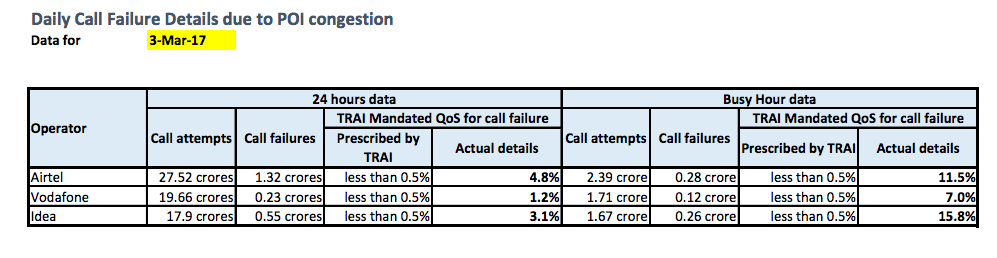
Mukesh Ambani-led Reliance Jio Infocomm on Thursday released call failure statistics for March 3 that revealed that 1.32 crore voice calls or 4.8% of total 27.52 crore calls made to Bharti Airtel’s network had failed. However, the call failure rate on Airtel’s network has come down significantly from 12.4% a month earlier.
The call failure rate on Vodafone and Idea Cellular networks is much lower at 3.1% and 1.2%, respectively. According to Jio’s data, 0.23 crores calls were failed out of 19.66 crores. Call attempts from Jio subscribers to Vodafone India’s network. Further, 0.55 crore calls were failed out of 17.9 crore call attempts from Jio subscribers to Idea Cellular’s network.
The Telecom Regulatory Authority of India (Trai) has prescribed less than 0.5% call failures to maintain the quality of service (QoS) among service providers.
Jio statistics reveal that busy hour call failure rate on networks of Airtel, Vodafone and Idea is much higher at 11.55, 7% and 15.8%, respectively.
jio-call-failure
Reliance Jio was earlier involved in a public spat with these incumbents over the availability of points of interconnections (PoI. Jio had alleged that inadequate supply of PoIs from these telcos led to massive call failures on rival networks.
Incumbents, however, denied Jio’s allegations, and even went on to blame Jio of its preparedness. The telecom regulator had last year recommended a penalty of Rs 3,050 crore on these top telcos for violating licence norms by denying adequate interconnection points to newcomer Jio.
Share: